Skip to content
Vibe Coding vs. Vibe Implementing: Guide AI, Own the Code
Learn to direct AI-assisted development with clear intent, sound engineering, and evidence. Avoid scope drift, overengineering, fragile shortcuts, and unsupported claims of scale.
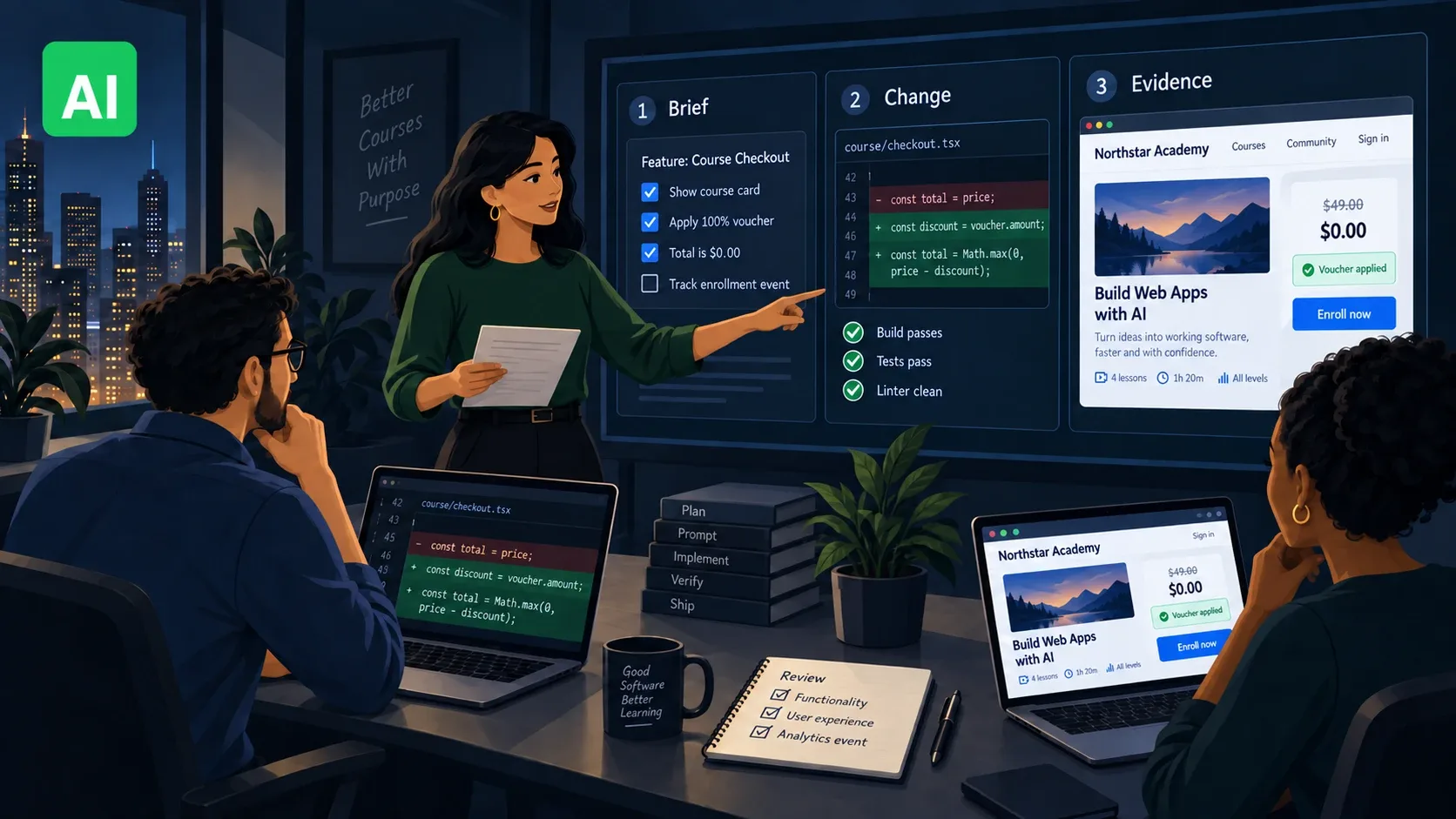
Decide what to build. Guide how it gets built.
AI can produce a convincing implementation before the problem is clear. Learn to keep ownership of the outcome: choose the right scope, understand the important technical boundaries, and verify the result before accepting it. Build judgment you can use with different coding assistants.
For builders who want to stay in control
For founders, product-minded developers, and early-career builders using AI who want more than prompt tricks. The decision track focuses on briefs and reviews. The full implementation track expects basic familiarity with JavaScript functions, objects, files, and running a command; extensive backend or production experience is not required.
What you will learn
Choose an appropriate level of AI autonomy and explain which decisions remain yours.
Trace a feature through its inputs, rules, state changes, and outputs, and identify where enforcement belongs.
Write a compact feature brief that prevents scope drift and exposes unanswered business questions.
Choose a proportionate design, justify its boundaries, and identify evidence that would trigger a different approach.
Give an assistant a focused change contract and review its scope before accepting the result.
Create evidence that can refute a bad proposal and distinguish tested behavior from unsupported confidence.
Identify the likely bottleneck, define useful measurements, and separate source publication from a working release.
Guide a small change from brief to verified handoff and explain why the chosen engineering is enough.
Practice with Northstar Academy
Work through an explicitly fictional catalog and voucher lab. Inspect plausible but flawed proposals, preserve meaning during a format conversion, and deliver a small course-and-voucher change without expanding the policy. Then transfer the same reasoning to bookings, inventory, or internal tools.
All scenarios and code proposals are invented teaching material. The course does not present a real platform’s development history or report incidents from one.
A complete path from intent to evidence
32 English text-and-code lessons across eight modules.
16 practical labs and eight debugging situations.
48 knowledge checks with answer commentary.
12 reusable templates for briefs, constraints, decisions, review, evidence, migration, scale, and delivery.
Complete copyable source for a local lab, three intentionally incorrect proposals, and a worked capstone.
A manual self-review rubric and a concrete final demonstration.
Plan roughly 18–26 hours for reading, exercises, implementation, and review. This is a study estimate, not video duration. There are no video lessons or live tutoring promises in this course.
Your learning path
1. Own the Direction
Distinguish exploration from accountable implementation and keep product decisions in human hands.
2. Know Enough to Ask Better Questions
Read data flow, contracts, side effects, and trust boundaries without needing to memorize a framework.
3. Specify Outcomes, Not Vague Wishes
Translate product intent into examples, invariants, and acceptance criteria the assistant can implement and you can verify.
4. Choose the Engineering the Problem Needs
Avoid both unnecessary architecture and fragile shortcuts by making trade-offs explicit.
5. Lead a Bounded Implementation
Supply useful context, delegate one coherent slice, and steer with evidence instead of endless corrective prompts.
6. Verify the Outcome and Protect the Data
Use independent expectations, negative cases, and migration rehearsals to detect plausible but incorrect implementations.
7. Reason About Scale, Cost, and Release
Replace vague scalability claims with workload assumptions, failure behavior, and a controlled delivery plan.
8. Deliver a Change You Can Defend
Combine product judgment, a bounded implementation, and evidence in one complete fictional product exercise.
Use a small toolset
A code editor, a current browser, and a supported Node.js release, version 22 or later, for the implementation track.
No package installation, AI API key, paid AI subscription, or real payment account required for the included lab.
Use an assistant you already have, or compare the supplied proposals without one.
Keep fictional data in the local exercises. The quote demo does not process payments or create real enrollments.
Finish with a change you can defend
Present the chosen outcome, one negative case, and a preserved previous behavior. Explain a design decision, a rejected alternative, a detected defect, and a remaining limitation. You should leave able to challenge an AI proposal—and recognize when its suggestion is worth adopting.