Skip to content
TypeScript in Production: Types, Contracts & System Design
Stop using TypeScript as decoration. Learn to model states, validate runtime boundaries, design APIs that infer clearly, protect package ownership, and operate typed systems through one cumulative production capstone.
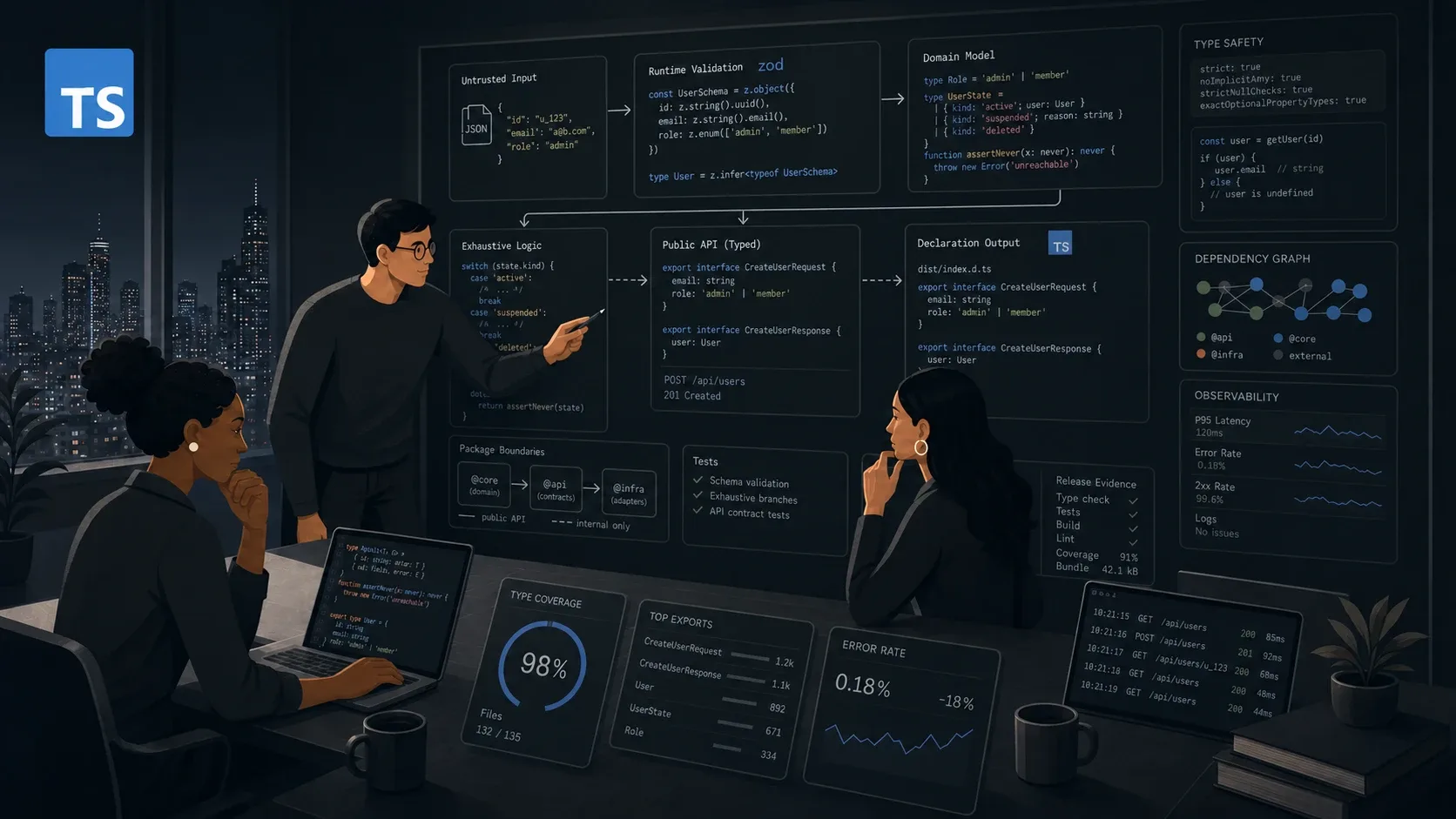
The gap this course closes
You can already write JavaScript and probably add interfaces, annotate functions, and fix compiler errors. The harder questions begin after that: What did the compiler actually prove? Where does runtime trust begin? Which type owns an API boundary? How do declarations become a release surface? When is a generic helping a caller, and when is it hiding a confused design? This course makes those decisions executable.
Begin with the reason TypeScript exists
Before syntax or compiler flags, Chapter 0 reconstructs the engineering problem TypeScript set out to solve. You will trace its 2012 public release, gradual JavaScript compatibility, structural and erasable type system, and compiler-versus-runtime boundary through one contract refactoring that fails late in JavaScript and becomes visible earlier with TypeScript checking.
Build Atlas, not disconnected exercises
A work-routing platform whose API, SDK, web application, and worker exchange explicit contracts without sharing private domain representations.
Atlas must preserve these invariants from the first checkpoint to the final defense: External values remain unknown until runtime validation succeeds. Every public contract has one owner and a documented compatibility policy. Domain states are represented by exhaustive discriminated unions. Public package exports reveal no private domain or adapter representation. Every intentional type-system escape has a local reason, boundary, and removal trigger. Compiler upgrades include declaration, behavior, performance, canary, and rollback evidence.
What you will be able to do
Predict inference and assignability; model exhaustive domain states; write trustworthy narrowing; design useful generic APIs; validate HTTP, configuration, queue, and storage inputs; separate DTOs from domain state; expose stable typed failures; evolve contracts; draw package ownership; inspect declarations; test valid and invalid call sites; migrate JavaScript incrementally; measure TypeScript 7; review AI-generated code; and release with canary and rollback evidence.
Current technical baseline
The tested baseline is TypeScript 7.0.2, Node.js 24.20.0, Bun 1.4.0, Zod 4.5.4, and node:test. Runtime- and release-sensitive claims were reviewed on 2026-08-30 and must be rechecked by 2026-11-28. The title remains version-independent because the course teaches maintenance, not a frozen release tour.
Six modules, one contract graph
The recommended path is one module per week for six weeks, about 36–46 hours in total. Every checkpoint strengthens the same Atlas repository; the sequence is guidance for preserving dependencies between decisions.
Know What the Compiler Proved
Start with the production problem TypeScript was designed to solve, then build a precise mental model of erasure, inference, assignability, literals, uncertainty, and compiler policy.
Model States That Cannot Lie
Use control flow, discriminated unions, trustworthy predicates, and named transitions to remove invalid Atlas states.
Design APIs That Infer the Right Thing
Use generics, constraints, mapped and conditional types only where they preserve a valuable public relationship.
Build Runtime Contracts
Validate unknown inputs, convert transport into domain state, model expected failures, and evolve independently deployed contracts.
Draw Boundaries Across a Codebase
Turn contracts, domain, API, SDK, web, and worker into owned projects with narrow exports and tested declarations.
Migrate, Release, and Operate Safely
Move JavaScript systems toward strict TypeScript, measure the native compiler, review AI output, and release public contracts with rollback.
The evidence you keep
You finish with a working Atlas system and these maintained artifacts: Compiler policy, Domain state map, Public API contract, Runtime trust map, Typed error catalog, Package boundary map, Type-test suite, JavaScript migration plan, Compiler-performance baseline, Release checklist, Atlas architecture decision records. Each artifact names ownership, assumptions, proof, failure conditions, review triggers, and rollback rather than existing as résumé decoration.
Assessment built around decisions
Each module ends with six production scenarios. Three architecture reviews force connected decisions across state, runtime trust, contract evolution, package ownership, and releases. Six debugging cases begin with incomplete evidence. The final bank contains twenty-four scenarios and presents fifteen per attempt. Questions test prediction, diagnosis, design, and proof—not syntax trivia.