Skip to content
React from First Principles: Build Your First Real App
Understand React from its origins to an app of your own. Build Tripboard while learning components, state, forms, effects, routing, accessibility, testing, and delivery.
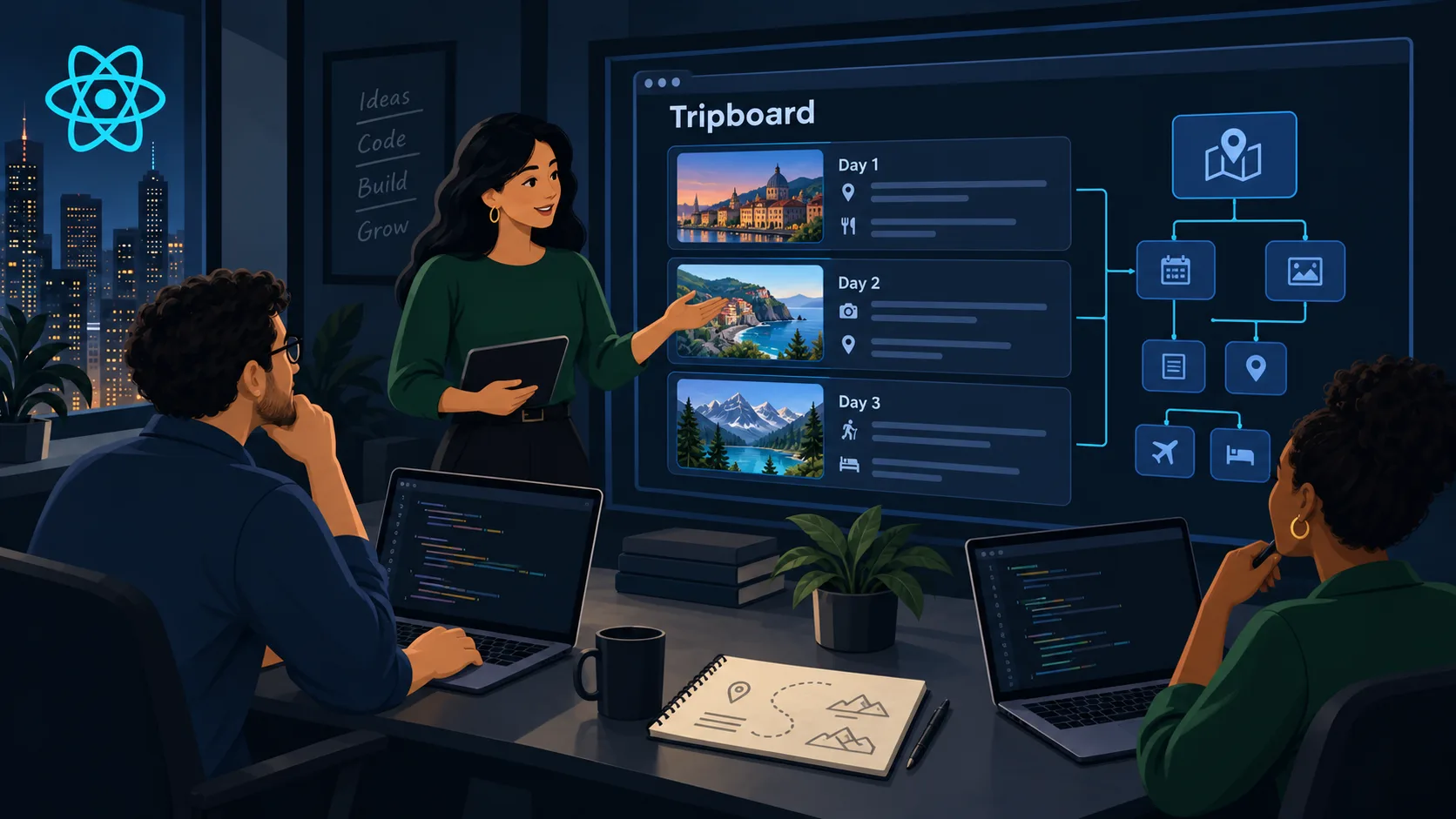
Understand the interface you are building
Move from JavaScript fundamentals to an application you can explain, test, and extend. Follow React from its origins to components, state, data, navigation, and a complete interactive project. Every new concept solves a visible problem in the same app.
Build Tripboard
Create a visual three-day travel planner with itinerary cards, favorites, notes, day and text filters, estimated totals, destination ideas, browser-local saving, multiple views, and plan export. Start with a static screen and develop it through eight complete checkpoints. Use fictional information and personalize your own version.
What you will learn
Explain the problem React addresses and run a small React project without confusing the library, JSX, build tools, and the browser.
Build a static interface from records and explain composition, props, and render purity.
Predict how events schedule updates and implement a favorite toggle without mutating existing records.
Choose stored versus derived state and implement accessible create, edit, filter, and remove interactions.
Distinguish events, rendering, and effects; handle asynchronous data and browser persistence with explicit recovery behavior.
Connect navigation, URL filters, a reducer, and context while preserving state ownership and browser behavior.
Use accessible semantics, meaningful automated tests, and measured performance evidence to evaluate an interactive app.
Deliver a reproducible static app, explain its limits, and make a new feature from a written acceptance contract.
Learn through decisions and experiments
Start with the problem React was created to address. Revisit history and useful surprises as the application grows: the stable arrival of Hooks, state snapshots, identity in filtered lists, development checks, request ordering, and the boundary between reusable logic and shared state. Predict a result, run a focused experiment, and compare your reasoning with an explained answer.
What the course contains
32 guided text-and-code lessons across eight modules.
16 hands-on labs and eight debugging investigations.
48 knowledge checks with answer commentary.
Complete, copyable project files for eight independent checkpoints.
Automated behavior tests covering forms, state transitions, storage, navigation, and request failures.
A final independent extension, a release checklist, and a self-review rubric.
Plan roughly 20–30 hours for reading, setup, experiments, labs, and your independent extension. This is a hands-on estimate, not a video running time. Repeat the exercises and keep your own evidence as needed.
Your learning path
1. Why React Exists
Trace React’s origins, compare update strategies, and run your first Tripboard screen.
2. Think in Components
Turn the Tripboard design into JSX, reusable components, and explicit data flow.
3. Understand State and Rendering
Make favorites interactive while learning snapshots, update queues, and immutable changes.
4. Model the Interface
Build forms, filtering, notes, and totals around stable records and clear state ownership.
5. Connect Data and External Systems
Load destination ideas, handle failures, and restore a plan without hiding storage or timing problems.
6. Organize an Application
Add routes, share the plan deliberately, and extract hooks without creating hidden global state.
7. Build with Confidence
Review keyboard behavior, test user-visible outcomes, and measure before optimizing.
8. Deliver a Product You Understand
Build and inspect the release, export a plan, and implement an independent extension with evidence.
A focused toolset
A code editor and a current desktop browser with Developer Tools.
Node.js 24.15 or newer in the 24.x line, with npm; setup commands are included.
React and Vite from the pinned checkpoint manifests, with React Router introduced for navigation.
Vitest and Testing Library introduced when the project has meaningful behavior to verify.
Finish with a product you can defend
Deliver your customized Tripboard, demonstrate its core interactions, and implement one original extension from written acceptance criteria. Keep a README, a test record, and an explanation of one defect you investigated. The final rubric helps you evaluate working behavior, data ownership, accessibility, recovery, and the clarity of your handoff.